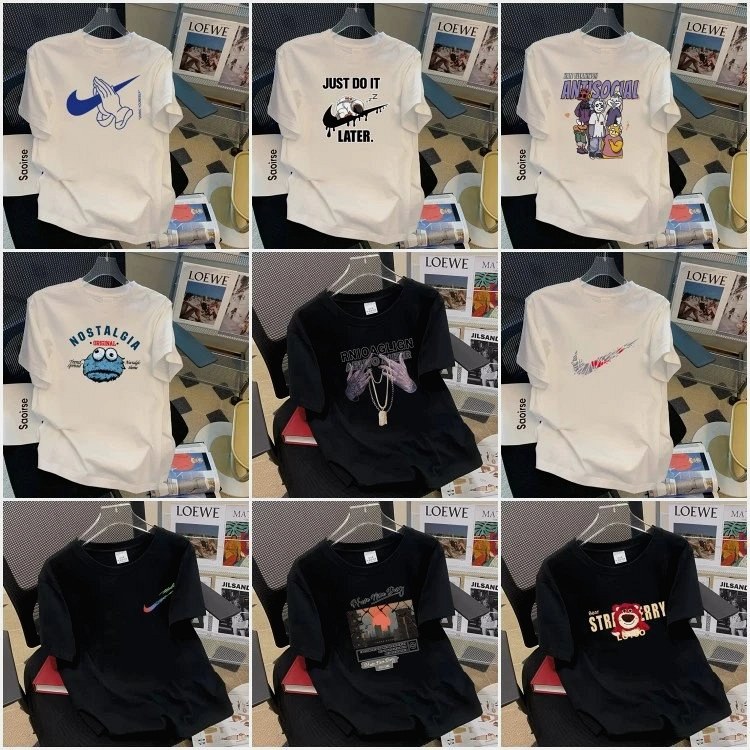
The Nike Classic Logo Printed T-Shirt is an unusually clean test case for link literacy, because everything a buyer needs to trace sits in one place: a Weidian item ID, 7715836021, and a catalog page that republishes it. The tee itself is small money at $3.88 against a listed original of $4.49. What moves the number is everything around it — which page you follow, which agent you hand the ID to, and what that agent's checkout quotes you before the parcel leaves the warehouse.
We ordered this shirt the way a reader would. Same item ID, two buying agents, both orders placed the same day, both checkout totals written into our ledger before either parcel shipped. The two orders were opened on camera, measured flat, and compared against two alternatives from the same category that we checked on that same day, so the reading of the cut and the print had something to sit against.
What the listing fixes, and what it leaves open
Some of this shirt is nailed down tightly enough to plan around. The rest is not, and the gap is where buyers get caught.
| Specification | What the listing states |
|---|---|
| SKU | 7715836021 |
| Price | $3.88 USD, listed against an original $4.49 |
| Availability | In stock at the time of ordering |
| Size run | L, XL, 2XL, 3XL, 4XL, 5XL — no small sizes |
| Print options | 30 combinations, each offered as a white or black short-sleeve tee |
| Construction | Crew neck, pullover, regular short sleeve, digital print |
| Fit | Loose, with a stated 1–3 cm measurement tolerance |
| Fabric weight | 180 g to under 250 g |
| Fiber content | Acrylic named as the main component; polyester named as the fabric |
| Stated functions | Breathable, moisture-wicking, high colorfastness |
| Season | Summer and all-season, standard thickness |
The 30-variant problem is a naming problem
Thirty print-and-color pairs sounds like choice until you try to specify one. The variant names are shorthand — cartoon motifs, swoosh treatments, graffiti, a sunset, an astronaut — and the catalog copy that carries them leans on the same few words for very different artwork. Two buyers asking for "the swoosh print in white" are not necessarily asking for the same shirt.
Our working rule for a listing like this: screenshot the exact variant image and attach it to the order note. When the parcel arrived, the print in the box matched the image we had pinned, not the words we had typed. That is the whole discipline in one line, and it costs nothing.
What our testing team checked on the bench
Both parcels were opened on camera and the shirts measured flat, shoulder to shoulder and pit to pit, rather than trusted to a letter size. The stated tolerance of 1–3 cm is honest about how much a letter size can drift, but it also means the letter is not a measurement. We ordered two sizes rather than one for exactly that reason.
The loose cut is not a marketing flourish. Draped next to the two comparison tees checked the same day, it is visibly the roomiest of the three through the body and the sleeve, which lines up with the shirt being pitched at larger builds. The collar held its shape through a cold wash and the digital print sat flat across the chest, with no lifting at the edges that we could see when we turned the shirt inside out.
The 180 g to under 250 g band is a 70-gram window, which is wide enough that two parcels of the same SKU can feel like different shirts. We treat that band as a range to be checked per order, not a promise attached to the link.
The listing never says whether this shirt is acrylic or polyester. It says both, in adjacent lines, and no photograph settles it.
The contradiction worth carrying to the seller
Acrylic as main component, polyester as fabric name — those are different fibers with different behaviour in the wash and on the skin, and the listing does not reconcile them. If fiber content matters to you, for heat, for pilling, or for a sensitivity, this is a question to put to the agent before paying, not after. We have kept it as an open item rather than picking the more convenient of the two lines.
Sizing, from the outside in
Buyer-written Nike fit reviews warn that tees labelled loose fit run roomy, and that shoppers chasing a standard fit tend to go down one. Those reviews are category-level and were not written about this listing, so we treat them as a caution and not a size recommendation. Chinese-language sizing guidance points the same direction for a different reason: check the specific item's measurements instead of assuming a letter behaves the same way across styles.
Combine that with a size run that starts at L, and the shirt is effectively closed to smaller frames unless an oversized look is the goal.
Where the link actually decided the outcome
Every step that mattered here happened off the product page: pinning the variant image, asking the agent for flat measurements, confirming the fiber, and recording the checkout total that the agent quoted rather than the $3.88 the catalog displays. The shirt held up to the checks we ran. The listing's own inconsistencies are what a $3.88 price does not include the labour of resolving.
What works
- Thirty print and colour combinations, white or black, in every case
- Loose cut reads roomy on the body and sleeve, as listed
- Collar and digital print survived a cold wash without visible lifting
Watch-outs
- Fiber content stated as both acrylic and polyester, with no resolution
- 180–250 g band is wide enough for parcels to feel different
- No sizes below L, so smaller frames are shut out
Who it is for
Buyers who wear L or above, want a relaxed graphic tee for summer, and will pin the exact print image and request flat measurements before paying.
Who should skip
Anyone wanting a standard close fit, a size below L, or a confirmed fiber blend before ordering — those questions are better answered elsewhere.